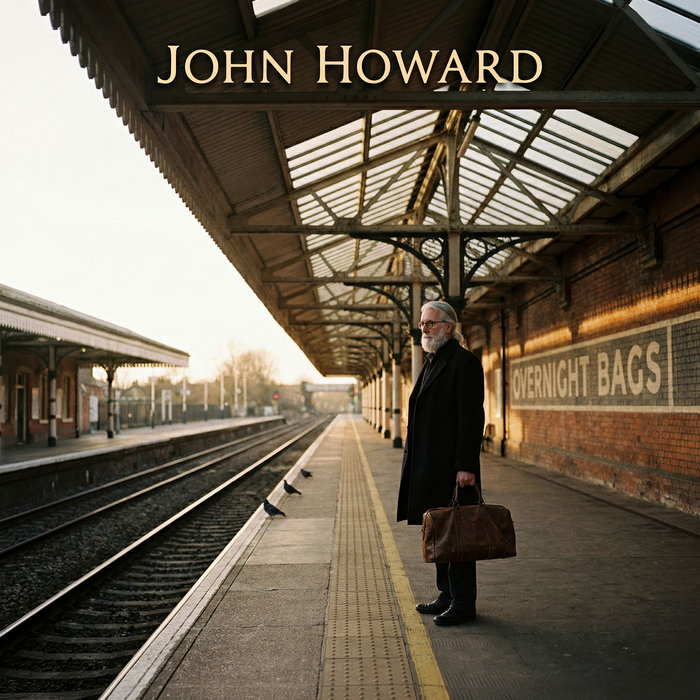
John Howard Packs Seventy-Three Years of Memories into Overnight Bags
John Howard’s new eleven-song album turns Chelsea glamour, an Abbey Road morning, the AIDS years, a father’s Alzheimer’s and the touring life into assured, piano-led pop.

John Howard has spent much of his second act watching the world catch up with his first. His 1975 debut, Kid in a Big World, disappeared almost as soon as it arrived, only to return decades later as the cornerstone of one of British pop’s most remarkable rediscoveries. Lost recordings surfaced. Shelved albums found their proper sequence. Applause that should have come in the seventies finally arrived in the twenty-first century.
But Overnight Bags, released by Think Like A Key Music on August 7, is not another excavation. It is an album about what Howard can see from where he stands now: seventy-three years of people, rooms, ambitions, departures and unexpected continuations.
“The songs are amalgams of memories of people I’ve known, places I’ve been, experiences which have shaped me,” Howard says.
He wrote, produced, arranged and mixed all eleven songs at La Casita Studios in Spain. Prof. Stoned mastered the finished album. The result is melodic, piano-led pop made with the ease of a writer who no longer needs to prove that he belonged in the room. He knows he did. What interests him now is remembering who else was there.
Chelsea, Soho and the day everything was supposed to begin
The album opens with “Chelsea Daze,” a bright King’s Road reverie populated by the beautiful people of 1960s London. Howard imagines himself as a fly on the wall while Edna O’Brien, Jackie Onassis, Robert Mitchum, Paul McCartney and other cultural figures drift through the same glamorous room. The names are real; the gathering is Howard’s invention. That movement between remembered detail and imagined possibility runs throughout the record.
“Songs of the Old Times” returns to a very different London interior: a rough Soho pub Howard visited during the 1970s, where strangers occasionally walked to the bar and burst into old songs. He never learned what the songs were, but the strange romance of the ritual stayed with him.
The past becomes most concentrated on “Abbey Road, April 1974.” Howard was twenty-one when he climbed the studio’s steps to begin recording Kid in a Big World. His manager, Stuart Reid, told him this was the day of his life—the moment he would step into the light and everything would begin.
Howard turns that memory into a jazz-tinted miniature of barely more than two minutes. The length is deliberate: a nod to the compact early Beatles singles made in the same building. What could have become an exercise in nostalgia instead captures the strange, suspended instant before a future reveals what it actually has planned.
When memory is the only way home
Several songs on Overnight Bags ask what memory can preserve after a person or place has changed beyond recognition.
“A Painter’s Gift” grew from Howard’s canvases of abandoned houses in his Spanish village. Behind their peeling doors, he imagines the families who once lived there and the histories that remain after a building has begun to collapse. In the song, a painting keeps a childhood home intact even as the physical house becomes rubble.
“My Father’s Prayer” is more direct. Howard’s father was diagnosed with Alzheimer’s at eighty-three and spent his final decade confused, frightened and repeatedly asking to be taken home. A photograph album offered brief returns. Pictures of relatives, jazz bands and old friends could bring back the father Howard remembered, if only for a few minutes.
The song does not tidy that experience into easy consolation. It understands that recognition can be both gift and wound: proof of the person still present and of how difficult it has become to reach him.
The silence after Mykonos
The album’s emotional center is “What God Is This?,” Howard’s remembrance of the gay community before and during the AIDS crisis.
He recalls Mykonos in the late seventies as a place of sun, desire, friendship and a growing belief that gay life had finally moved out of society’s margins. Then funerals replaced lunches. Brilliant, crowded conversations dwindled. Howard and his husband, Neil, lost friend after friend while the epidemic was met with fear, hostility and renewed bigotry.
The song asks how intimacy and shared pleasure could so quickly become associated with death—and how a community that had begun to feel visible could again be treated as a threat. Its final image returns to the beach, but the laughter has gone. Only the sea remains.
The show closes, the bags are packed
Howard allows wit and theatrical shadow back into the album before the curtain falls. “The Room at the Top of the Stairs” turns a childhood visit to an abandoned house into a slightly Neil Hannon-ish gothic tale. “Josie, Do You Remember?” combines several school and art-college friends into one gloriously carefree companion.
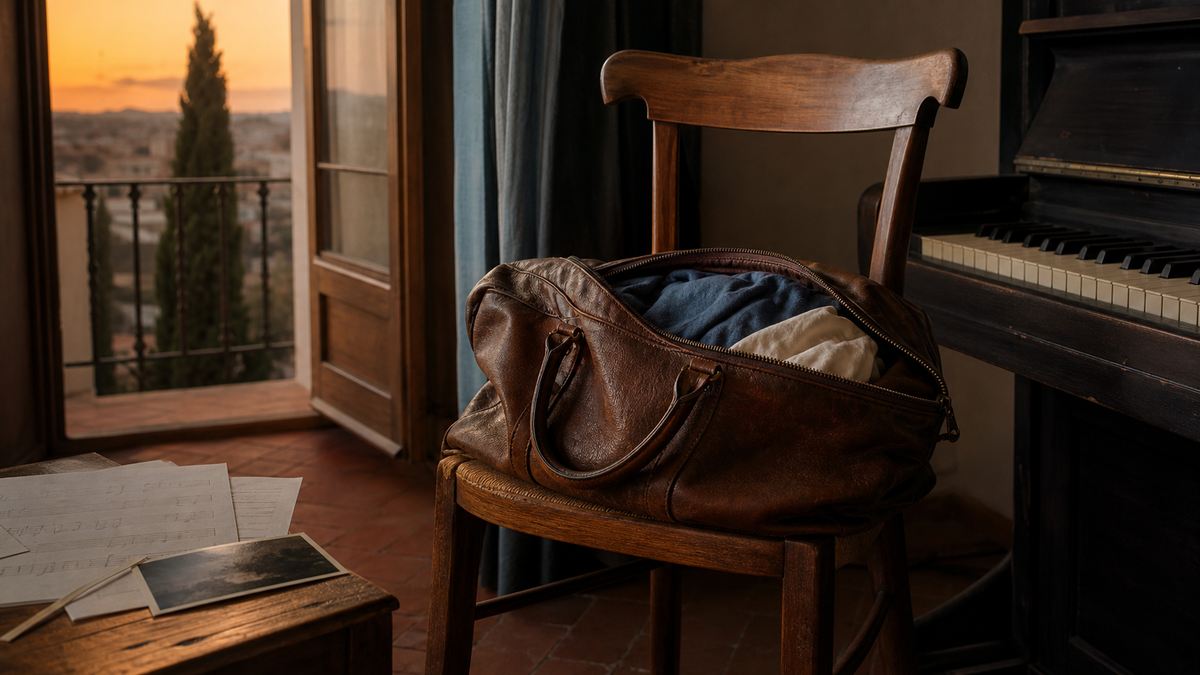
The title track closes the record in the temporary world of touring theatre. It was inspired by Howard’s husband’s years as a professional actor, moving from production to production and forming intense friendships that often ended when the final curtain came down. The song adds a fleeting romance to that life: two people close enough to share a room, but already aware that one of them will soon pack an overnight bag and move on.
That could sound like an ending. In Howard’s hands it feels more like an understanding. People leave, buildings crumble, photographs fade and careers take routes nobody predicted. The work is to notice what remains—and, when possible, turn it into a song before the next train departs.
Overnight Bags is released August 7, 2026, on made-on-demand CD, LP on demand and ElasticStage CD. Order it, or hear the available tracks on Bandcamp.
 John Howard